
The first direct US-Iran talks since 1979 are over, and there is no deal.
Vice President JD Vance flew out of Islamabad on Saturday after 21 straight hours of negotiations with Iranian officials produced what he called a "final and best offer" that Tehran would not accept. The core dispute: Iran's nuclear program.
"We need to see an affirmative commitment that they will not seek a nuclear weapon, and they will not seek the tools that would enable them to quickly achieve a nuclear weapon," Vance told reporters before boarding his plane. He described that demand as President Trump's "core goal" for the talks.
Iran's delegation, led by parliamentary speaker Mohammad-Bagher Ghalibaf and foreign minister Abbas Araghchi, walked away from those terms. Tehran's foreign ministry later downplayed the outcome, calling it "natural" that a single day of talks would not produce a finished agreement and noting progress on unspecified points. State media took a harder line, blaming Washington's "excessive demands" for blocking progress.
What each side wanted
The gap between the two delegations was wide from the start.
Washington arrived with two priorities: a binding commitment on nuclear weapons and the full reopening of the Strait of Hormuz. Vance said the US showed flexibility on other issues but drew a hard line on both.
Iran came with a longer list. Araghchi and Ghalibaf pushed for immediate sanctions relief, access to frozen Iranian funds, recognition of Iran's right to enrich uranium, and, most importantly, guarantees that Israel would stop bombing Lebanon and leave Hezbollah alone. Tehran also wants war reparations and a formal protocol for Hormuz that preserves Iranian control over the strait.
Those demands echo the 10-point proposal Tehran circulated last week, which included a $2 million ship transit fee and full sovereignty over Hormuz waters.
Navy moves complicated the room
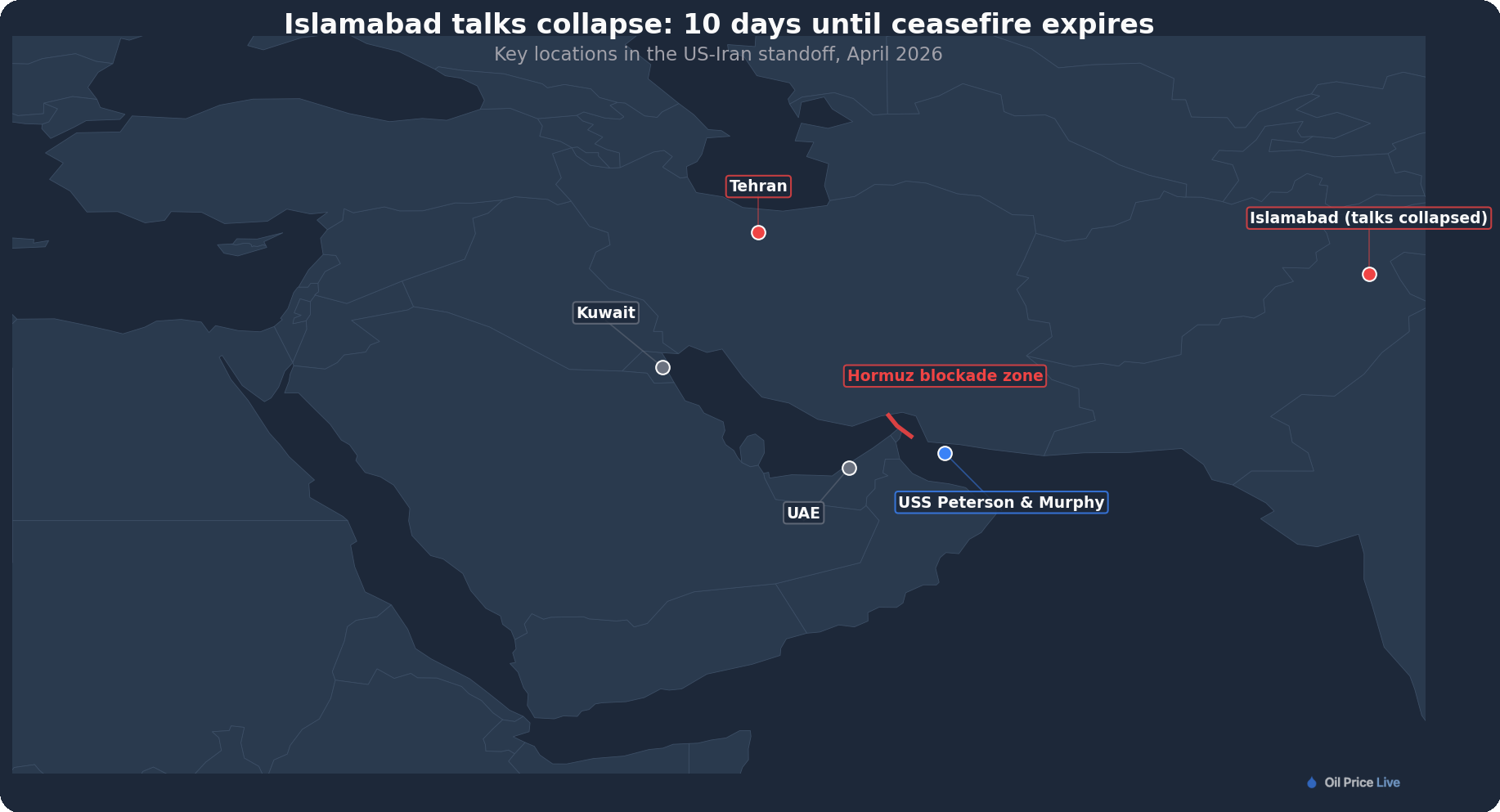
While diplomats talked, the US military acted. Two guided-missile destroyers, the USS Frank E. Peterson and the USS Michael Murphy, pushed into the strait on Saturday to start sweeping for mines. CENTCOM confirmed that more assets, including unmanned underwater vehicles, were on the way to support the operation.
Iran accused Washington of violating the ceasefire. The IRGC Navy sent a surveillance drone toward the two warships, and Bloomberg reported that the destroyers eventually reversed course. An IRGC statement warned that only civilian ships would be permitted to transit the strait, and only under conditions set by Tehran.
That standoff underscored a basic tension in the talks: the US wants Hormuz open unconditionally, while Iran treats it as its strongest card.
Ten days left on the clock
The Pakistan-brokered ceasefire, agreed on April 8, expires on April 22. No follow-up round of negotiations has been scheduled. No date, no venue, no format.
Pakistan's foreign minister Ishaq Dar put a positive spin on the outcome, describing the session as productive and urging both governments to hold the truce no matter what. Prime Minister Shehbaz Sharif and the army chief were both directly involved in the mediation.
But spin does not change the math. Ten days from now, the ceasefire lapses. If no progress is made, the war resumes with all its consequences for oil markets and shipping lanes.
Oil markets stuck in limbo
Crude prices barely moved on the news. WTI settled at $96.57 a barrel, down 1.35%, with Brent at $95.20, off 0.76%. Both benchmarks have been drifting lower since the ceasefire crashed prices from above $116 on April 7 to under $94 by midweek.
But that drop is misleading. Even at current levels, oil is nearly 40% above where it traded in February before the war. The ceasefire brought prices down from panic levels, but it did not bring them back to normal. The market has priced in a fragile pause, not a resolution.
Traders are now watching two things: whether Iran allows any commercial shipping through Hormuz before April 22, and whether a back channel emerges for further talks. If neither happens, expect crude to test $100 again well before the deadline.
What comes next
Vance framed the collapse as a pause, not an ending. "We put forward the best offer we could," he said, leaving the door open for Tehran to come back. Iran's foreign ministry struck a similar tone, saying the "ball is in America's court."
Neither side has an obvious next move. Trump could escalate militarily (the mine-clearing operation may be a preview) or offer new terms through Pakistan. Iran could quietly signal flexibility on the nuclear file, or dig in and let the ceasefire expire.
The most likely outcome for the next 10 days is nothing visible happening at all, followed by a scramble on April 21.